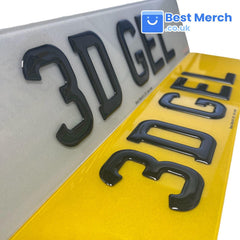

Are 4D Number Plates Legal
, by Reece Dennis, 4 min reading time
, by Reece Dennis, 4 min reading time
Are 4D Number Plates Legal in the UK?
If you're looking to add a touch of style and sophistication to your vehicle, you may have considered getting 4D number plates. But before you make a purchase, it's important to understand whether these plates are legal in the UK.
In recent years, 4D number plates have gained popularity for their unique design and eye-catching aesthetic. Unlike traditional plates, these plates use a different font and layered design to create a three-dimensional effect.
But are they legal? The answer is yes, as long as they meet certain criteria. According to the Driver and Vehicle Licensing Agency (DVLA), 4D number plates are legal if they comply with all the rules and regulations set for regular number plates. This means that they must contain the correct font, size, and spacing, and be made from reflective material.
It's also essential to remember that altering or modifying number plates in any way that could obscure or make them hard to read is against the law. So, if you're considering getting 4D number plates, make sure they are compliant with the DVLA's requirements to avoid any legal issues.
In conclusion, 4D number plates are legal in the UK as long as they meet the DVLA's guidelines. With their stylish design, they can be a great way to personalise your vehicle while staying within the legal boundaries.
When it comes to number plates in the UK, there are strict regulations in place to ensure their visibility and clarity. Number plates serve as a unique identifier for vehicles, helping authorities to track and monitor them. These regulations are put in place to ensure that number plates are easily readable and distinguishable, even in adverse weather conditions or under different lighting conditions.
4D number plates have gained popularity in recent years due to their unique design and aesthetic appeal. Unlike traditional number plates, 4D plates use a different font and layered design to create a three-dimensional effect. Many vehicle owners are drawn to these plates as they offer a touch of style and sophistication to their vehicles.
The legality of 4D number plates in the UK is a commonly asked question. The answer is yes, 4D number plates are legal in the UK, as long as they comply with the rules and regulations set for regular number plates. The Driver and Vehicle Licensing Agency (DVLA) has laid out specific guidelines that must be followed to ensure compliance.
To be considered legal, 4D number plates must meet the same requirements as regular number plates. These requirements include the correct font, size, and spacing, as well as being made from reflective material. The font must be the standard Charles Wright font, which is the same font used on regular number plates.
The size of the characters on the number plate must also meet the DVLA's specifications. The height of the characters should be 79mm, with a width of 50mm, except for the number 1 or letter I, which should have a width of 44mm. The space between the characters, both horizontally and vertically, must also meet specific measurements.
It's worth noting that 4D number plates should not be altered or modified in any way that could obscure or make them hard to read. Any alterations that affect the visibility or clarity of the number plate can result in legal consequences.
Using illegal number plates, including 4D number plates that do not comply with the DVLA's guidelines, can result in various consequences. The most common consequence is a fine, which can range from £60 to £1,000. In some cases, vehicle owners may also receive penalty points on their driving license. Repeat offenders can face more severe penalties, including the possibility of having their vehicle seized.
It's essential to understand that the purpose of number plate regulations is not to restrict vehicle owners but to maintain road safety and ensure that vehicles can be easily identified. By adhering to the guidelines set by the DVLA, vehicle owners can avoid legal issues and potential fines.
Yes, 4D number plates can be legal in the UK, but only if they fully comply with DVLA regulations. The key factor is not the style, but whether the plate meets the required standards for font, spacing, reflectivity, and visibility.
Yes, if they are compliant. Legal 4D plates do not block, distort, or confuse ANPR systems. However, illegal designs intended to obscure cameras may result in fines or vehicle stops.
It depends. Some sellers incorrectly market “4D gel plates”, but gel plates are typically classed as 3D gel, not true acrylic 4D. As with all plates, legality depends on DVLA compliance—not the marketing term.
No. Tinted backgrounds, smoked finishes, or coloured characters are not legal, even if the plate is 4D. Only black characters on reflective white/yellow backgrounds are permitted.
Generally, no, as long as the plates are DVLA compliant and purely cosmetic. However, if the plates are non-standard or modified beyond regulations, it’s best to inform your insurer to avoid issues.
No. Show plates are not legal for road use, regardless of whether they are 4D. Legal 4D plates must be registered, compliant, and supplied by a registered plate maker.